Empowering your business with scalable, secure, and highly efficient logistics solutions tailored to your unique supply chain needs.
The Australian logistics and warehousing sector is currently facing an unprecedented crisis in human capital. A severe and sustained shortage of qualified forklift operators, pick-and-pack staff, and warehouse managers has created massive operational bottlenecks across the industry. As consumer demand—particularly driven by the relentless growth of e-commerce—continues to surge, the traditional model of simply hiring more staff to scale operations has completely collapsed. MJP Logistics recognizes that the only sustainable path forward is a fundamental structural shift toward advanced automation and robotics.
Relying exclusively on manual labor in a high-volume warehousing environment is no longer just an inefficiency; it is a critical point of failure. Manual picking processes are prone to high error rates, workplace fatigue, and severe productivity drop-offs during peak surge periods. Furthermore, the rising cost of labor significantly degrades the profit margins of supply chain operations. To maintain high-velocity fulfillment without sacrificing accuracy or escalating costs, integrating robotic solutions is now an imperative, not a luxury.
"Automation does not replace the human element; it elevates it. Robotics handle the repetitive, physically taxing transit of goods, allowing human personnel to focus on complex problem-solving and quality control."
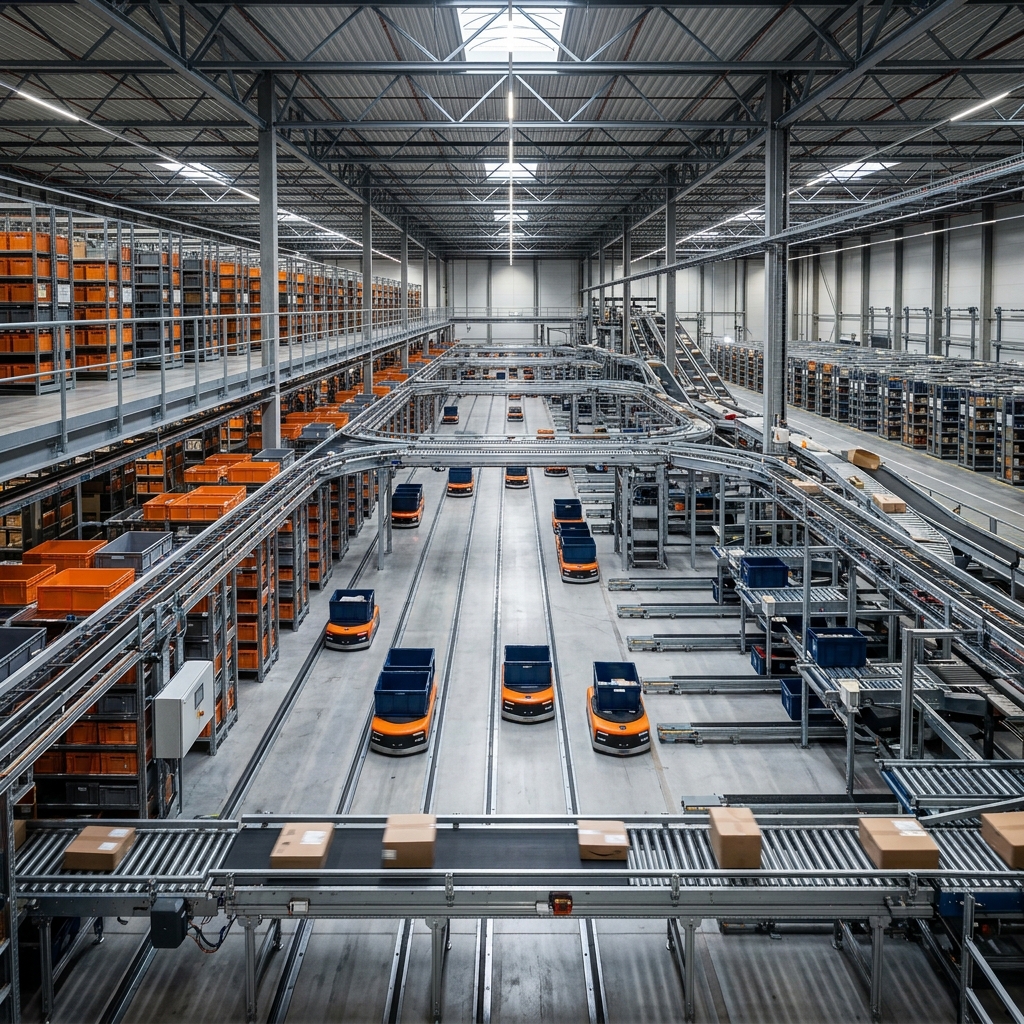
At MJP Logistics, we observe that the highest Return on Investment (ROI) in warehousing automation comes from the deployment of Automated Storage and Retrieval Systems (AS/RS) and Autonomous Mobile Robots (AMRs). These technologies drastically redefine the physics of the warehouse. Instead of a human worker walking several kilometers a day pushing a cart to retrieve items (the 'Person-to-Goods' model), the system utilizes robotic shuttles to retrieve the exact storage bin and deliver it directly to a stationary worker (the 'Goods-to-Person' model).
This fundamental inversion of the picking process yields staggering productivity gains. A standard manual warehouse picker might average 60 to 80 units picked per hour. When integrated into a 'Goods-to-Person' robotic ecosystem, that same worker can comfortably pick 300 to 500 units per hour with near-perfect accuracy. This allows logistics facilities to process triple the volume of outbound orders without requiring a single additional hire, effectively neutralizing the impact of the labor shortage.
Beyond raw speed, robotics fundamentally alter space utilization. Traditional human-operated forklifts require wide aisles (typically 3 to 4 meters) to maneuver safely. Automated high-density robotic grids require zero aisle space; goods are stacked tightly and retrieved vertically by shuttles. This allows a facility to store up to 40% more inventory within the exact same square footage, maximizing the value of the real estate.
Furthermore, automation eradicates the human error inherent in manual data entry and visual identification. The robotic systems are driven entirely by barcode and RFID scanning protocols. The system cannot physically select the wrong item. MJP Logistics views the integration of these technologies as the definitive blueprint for the future of Victorian logistics, ensuring that our operations remain scalable, perfectly accurate, and entirely immune to labor market volatility.